Consumption layer
Trace report pages, visuals, bindings, filters, Excel access, exports, and subscriptions back to their dependencies.
 Request a demo
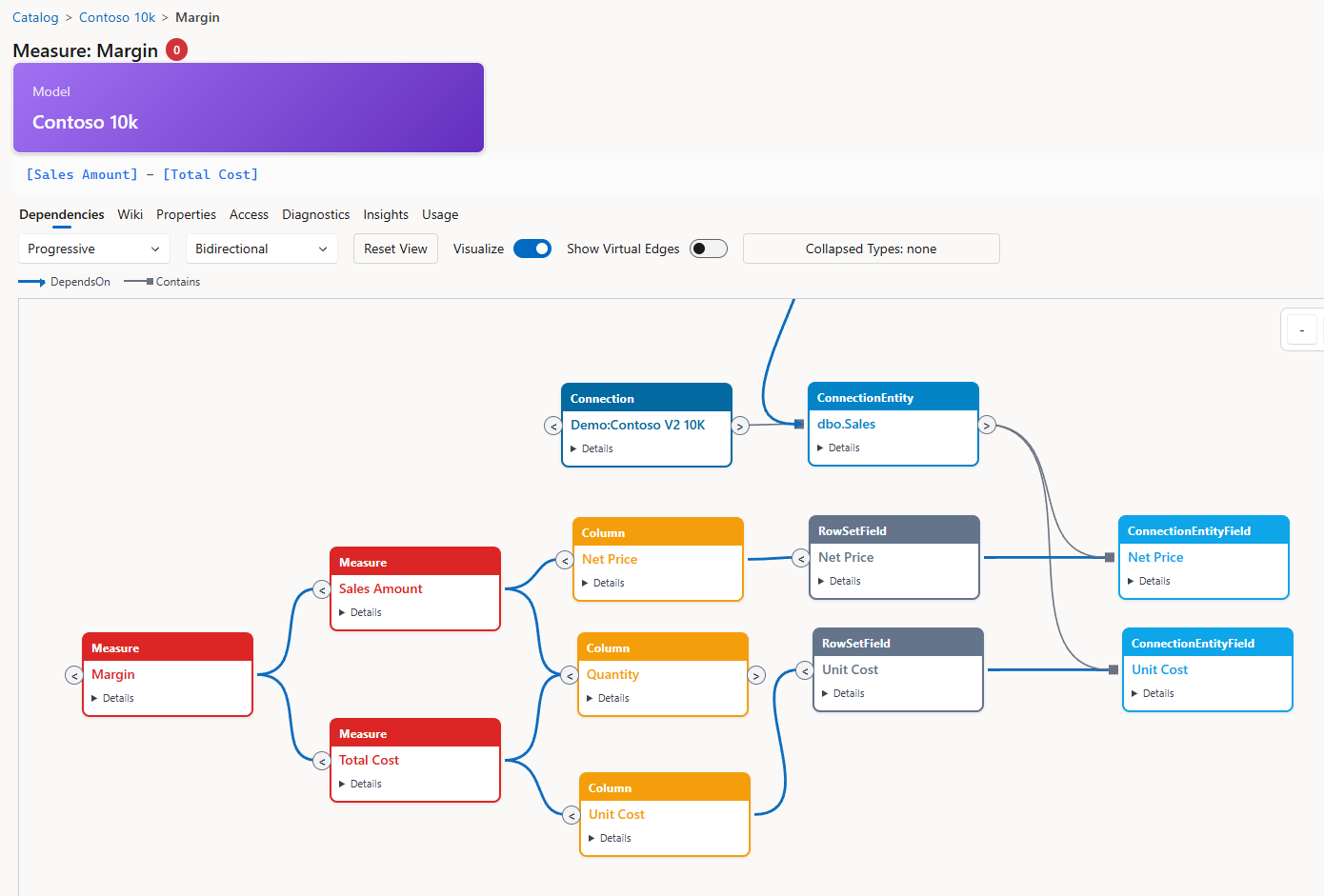
Fabric Lens resolves the technical relationships that connect your reports, semantic models, transformations, and sources. It gives teams a dependency graph they can use to understand impact before change.
Resolved analysis
Definitions get analyzed, not guessed at — report visual bindings, DAX, model objects, notebook code, pipelines, and queries — each one resolved to the objects and fields it actually represents.
Dependency coverage
Trace report pages, visuals, bindings, filters, Excel access, exports, and subscriptions back to their dependencies.
Resolve tables, columns, relationships, measures, and DAX expressions in the models that define business logic.
Understand Power Query, dataflows, pipelines, partitions, and notebook code that transform and move data.
Connect lineage to lakehouses, warehouses, SQL Server, Databricks, gateways, and other configured sources.
Remote lineage plugins
Remote plugins extend the same dependency analysis into connected systems. SQL Server lineage uses metadata and module parsing to continue behind views; Databricks lineage uses its metadata and lineage system tables.
Lineage extended into
Cataloged alongside Fabric and Power BI
Operational value
The same resolved graph backs impact analysis, documentation, diagnostics, and model cleanup elsewhere in the platform — it isn't a separate feature, just the same dependency data reused.
Coverage by layer
Each row is one layer of the estate, starting at the report and working back to the source. A full marker means the trail resolves to the individual field: the column, measure, or binding involved. A half marker means it stops at the table, model, or report. Fabric Lens parses the definitions at every layer, including notebook code, with nothing to install in Spark.
| Layer | Fabric Lens | Power BI tools | Microsoft | Enterprise data catalogs | ||||||
|---|---|---|---|---|---|---|---|---|---|---|
| Measure Killer | Power BI Sentinel | Purview | Alation | Atlan | Collibra | Dataedo | DataHub | Manta | ||
Consumption Where people see the data. | ||||||||||
| Power BI report visualsFields, filters, and conditional formatting on each visual | Field level | Field level | Object level | Object level | Object level | Object level | Object level | Object level | Object level | Object level |
| Paginated reportsDataset fields and parameters in RDL | Field level | Field level | Not documented | Not documented | Object level | Not documented | Not documented | Object level | Object level | Not documented |
| ExcelPivotTables and workbooks connected to a semantic model | Field level | Field level | Not documented | Not documented | Not documented | Not documented | Not documented | Not documented | Not documented | Not documented |
Semantic Where business logic is defined. | ||||||||||
| Measures and columnsWhich measures, columns, and relationships use each field | Field level | Field level | Object level | Object level | Field level | Object level | Field level | Field level | Object level | Object level |
| Models built on other modelsComposite models and DirectQuery to a semantic model | Field level | Field level | Not documented | Not documented | Not documented | Not documented | Not documented | Not documented | Not documented | Not documented |
Preparation Where data is shaped and moved. | ||||||||||
| Power QueryM steps in models and in Gen1 and Gen2 dataflows | Field level | Field level | Object level | Object level | Object level | Object level | Object level | Object level | Object level | Object level |
| SQL queriesSQL sent to the source from a model or dataflow, including Value.NativeQuery | Field level | Field level | Object level | Not documented | Object level | Object level | Object level | Field level | Field level | Object level |
| NotebooksPySpark and Spark SQL, following %run into child notebooks | Field level | Not documented | Not documented | Not documented | Not documented | Field level OpenLineage, preview | Not documented | Not documented | Field level Spark agent | Not documented |
Source Upstream of Fabric and Power BI. | ||||||||||
| Warehouse objectsTables, views, and stored procedures behind the model | Field level | Not documented | Object level | Field level | Field level | Field level | Field level | Field level | Field level | Field level |
Field levelObject levelNot documented
Other tools are assessed from their published lineage documentation, linked from each name. A tool that links whole items without the tables involved, such as a notebook to a lakehouse, is shown as not documented. Runtime capture through OpenLineage or a Spark agent records only code that has run, and has to be configured in each Spark environment.
Next step
Discuss the source systems, transformations, and reporting layers Fabric Lens can connect for your organization.